
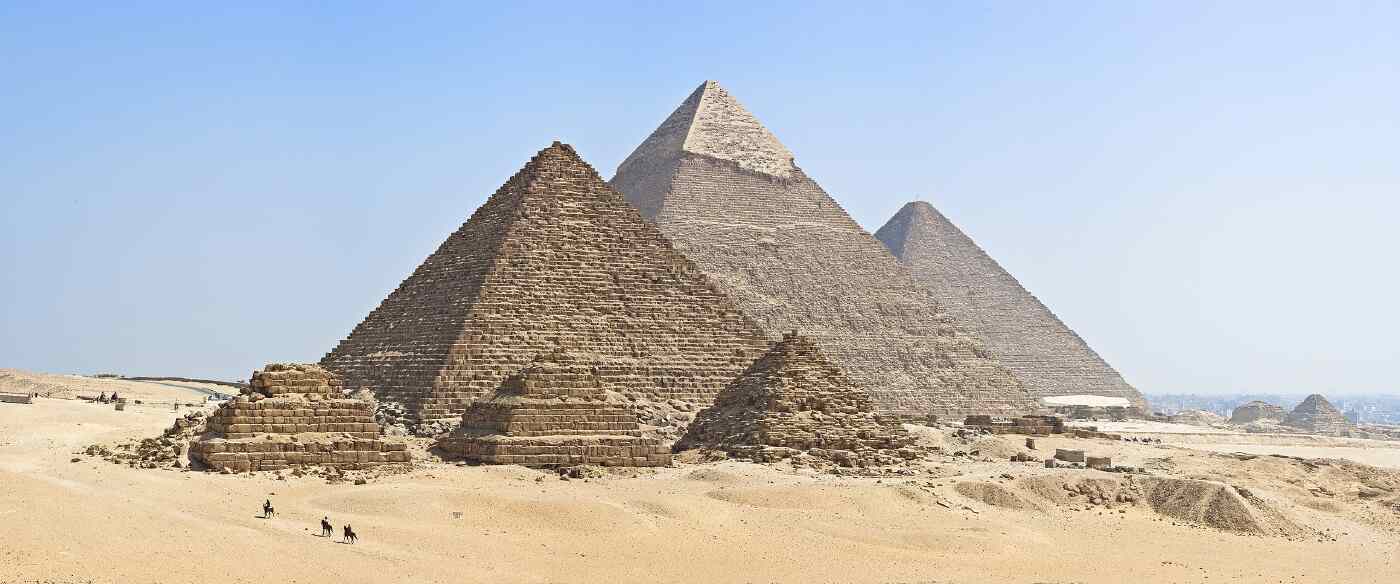
Scientists debate a controversial new radar discovery under pyramids of Giza, claiming eight massive tubes and a lost underworld city hide beneath the sand.
Modern technology meets ancient mystery in a revelation that has shaken the archaeological world. A research team claims satellite radar has revealed impossible megastructures hidden in the bedrock. While skeptics urge caution, these findings could rewrite history, hinting at a lost legacy buried deep beneath the sands of Egypt.
The Megastructures of Giza
In March 2025, a press conference held in Bologna, Italy, sent shockwaves through the community of historians, archaeologists, and enthusiasts of the ancient world. The subject was the Second Pyramid of Giza, the tomb of the Pharaoh Khafre, but the focus was not on the limestone blocks we can touch, but rather on what remains unseen. The Khafre SAR Project, a team led by Professor Corrado Malanga, Professor Filippo Biondi, and author Armando Mei, presented data that suggests the existence of a technological marvel hidden from history.


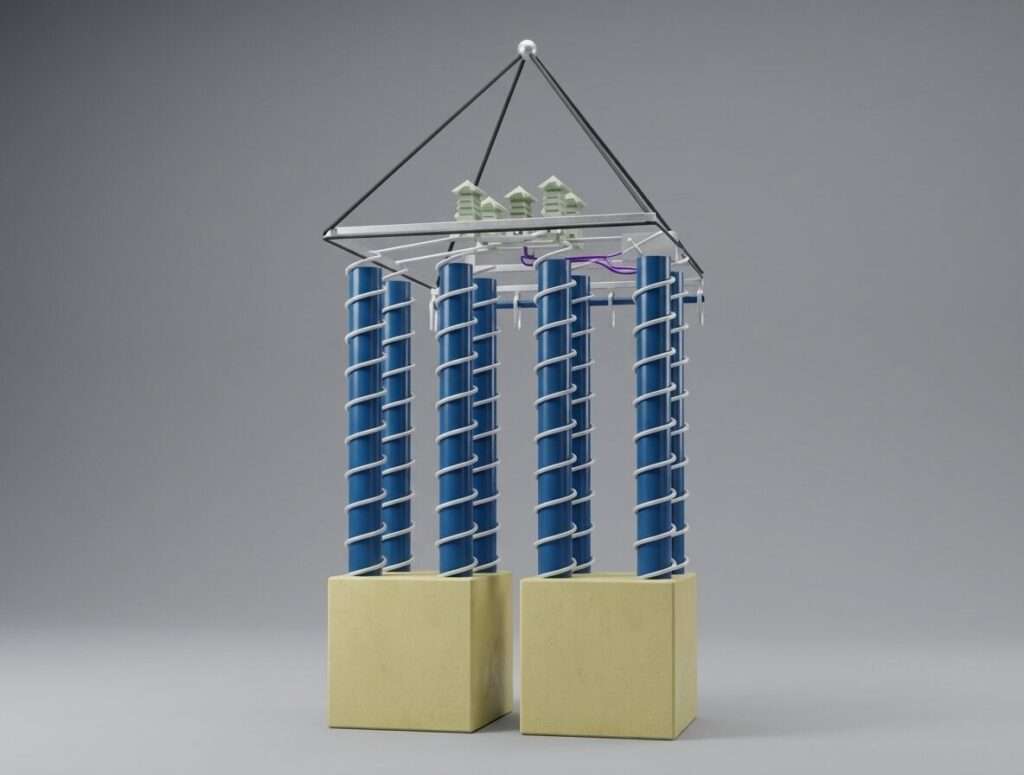
Using Synthetic Aperture Radar (SAR) data derived from satellites orbiting 400 miles above the Earth, the team produced imagery that depicts a complex series of voids. According to the report provided by researcher Andrew Collins, the Italian team identified “five vertical spaces, similar in appearance to the Relieving Chambers above the King’s Chamber inside the Great Pyramid.” However, the true sensation lies in what they found further down. The team claims to have identified a massive discovery under pyramids of Giza: a network of eight hollow cylindrical tubes penetrating the bedrock to a staggering depth of 648 meters—nearly half a mile down.
These are not mere cracks in the stone. The SAR imagery reportedly describes spiraling pathways winding around each of these vertical pipes. These tubes are said to be arranged in two precise rows of four, oriented north-south, eventually converging into two colossal cubic chambers. The scale is difficult to comprehend, with each chamber estimated to be approximately 80 meters wide. If these data interpretations hold true, we are looking at an engineering feat that defies conventional timelines of human history.
The Science of Shadows and Echoes
To understand this potential breakthrough, one must understand the tool used to find it. Synthetic Aperture Radar is not a camera; it is a way of “listening” to the ground from space. Satellite transmissions reflect off ground-based objects, containing seismic data recorded by computers. As noted in the report, mathematics is applied to this raw data to create composite 2D and 3D images. These images are color-coded: blue indicates dense rock, while brighter colors like red and yellow signify hollows and voids.
However, extraordinary claims require extraordinary scrutiny. The excitement surrounding this discovery under pyramids of Giza was immediately met with skepticism from veteran researchers. Andrew Collins, a private researcher who has extensively cataloged the Giza plateau, notes that while the claims are fascinating, the methodology requires transparency.
Online commentators and researchers have been quick to point out inconsistencies. Geoffrey Drumm, of “The Land of Chem,” highlighted a significant issue: the SAR scans allegedly failed to pick up known structures within the Great Pyramid while detecting these new anomalies. Furthermore, a void detected by the scan above the Grand Gallery did not match the location of the void confirmed by the separate Scan Pyramids Project.
Geologist Robert Schoch also weighed in, advising extreme caution. He raised a hydrological reality check: the Giza plateau’s water table. Fed by the nearby Nile, the water table would likely penetrate any structures that deep, filling them with water and making them inaccessible. As Collins writes, “There is every reason to consider the possibility that the Italian team’s findings are incorrect,” yet he also argues that we should not entirely discard the data. The “ghosts” in the radar might be misinterpretations of natural geology, or they might be the water-filled remnants of something far older than the Pharaohs.
The Cave Underworld and the Elder Culture
The narrative takes a turn from the technological to the historical when we consider the context of the plateau. This isn’t the first time voids have been reported here. As far back as 1977, the Stanford Research Institute (SRI) detected anomalies and potential voids beneath the Second Pyramid. Furthermore, a massive cave system, accessed via the “Tomb of the Birds” (North Cliff #2), exists on the plateau’s edge.
Andrew Collins suggests that if the Italian team’s radar data is detecting actual cavities, they may be connected to this natural cave underworld, which was lost to time and rediscovered in 2008. The linear shadows seen in the radar imagery converge near the northwest corner of the Second Pyramid—exactly where the known cave system extends.
If these structures are real, who built them? The conventional timeline places the construction of the pyramids around 2500 BCE. However, ancient Egyptian texts, such as the Edfu Building Texts, speak of an “Elder Culture” that existed before a great cataclysm. This cataclysm, described as a period of darkness and violent flooding, sounds suspiciously like the Younger Dryas impact event around 10,800 BCE.
Collins speculates on a connection to the sophisticated prehistoric cultures of Anatolia (modern-day Turkey), specifically the “Taş Tepeler” culture responsible for Göbekli Tepe and Karahan Tepe. We know there was contact; specific stone tools known as “Helwan Points” have been found both at Giza and in these Turkish Neolithic sites. Is it possible that the architects of the stone pillars in Turkey also laid the foundations for a subterranean complex in Egypt?
The Myth of the Eight
Perhaps the most compelling argument for the existence of these eight mysterious tubes comes not from science, but from mythology. The number eight is not random in Egyptian cosmogony. In Hermopolis, the creation myth centered on the “Ogdoad”—eight primeval beings who existed before the creation of the world.
The Ogdoad consisted of four pairs of male and female deities. The males were depicted with the heads of frogs, the females with the heads of snakes. They represented the fundamental state of the universe before order: darkness (Kuk/Kuket) and the primordial waters (Nun/Nunet).
The SAR data describes eight tubes, arranged in pairs, plunging into the deep, dark bedrock. As Collins notes, “Is it possible that this cosmogony of the Ogdoad alludes to the existence and function of the eight tubular well-like structures beneath the Second Pyramid at Giza?”
If these tubes penetrate the water table, they would be filled with the “primeval waters” of the aquifer, existing in total darkness—a perfect physical manifestation of the Ogdoad myth. The local legends of Nazlet el-Samman have long spoken of a vast lake beneath the plateau. The ancient Egyptians may have viewed these deep, water-filled shafts as the literal dwelling place of the forces of creation, the gateway to the “Halls of Amenti,” the destination of the dead.
A Connection to the Sabians
The mystery deepens when we look at medieval accounts. The Sabians, a people from Harran in southeastern Turkey (the same region as Göbekli Tepe), made pilgrimages to Giza. They believed the Second Pyramid was the tomb of Hermes (the Greek equivalent of Thoth). Why would people from Turkey venerate a specific pyramid in Egypt?
If the Taş Tepeler culture of Turkey migrated south after the Younger Dryas cataclysm, carrying their architectural knowledge and their myths with them, they may have established the sanctity of the Giza plateau millennia before the dynastic Egyptians built the pyramids we see today. The Sabians may have been preserving a memory of their ancestors’ work—a memory of what lies beneath.
Conclusion: The Need for Transparency
The claims made by the Khafre SAR Project are audacious. They challenge our understanding of geology, engineering, and history. The idea of a “city” or a massive industrial complex nearly a kilometer underground sounds like science fiction. However, the convergence of radar anomalies, geological faults, and specific creation myths creates a picture that is hard to ignore.
As the report concludes, the Italian team “should be encouraged to continue their work, while at the same time offering complete transparency.” We need more than color-coded images; we need peer-reviewed data and, ideally, physical exploration.
Whether these anomalies are natural fissures misinterpreted by software or the remnants of a lost epoch of human engineering, the discovery under pyramids of Giza has reignited the world’s imagination. We are reminded that despite centuries of study, the Great Pyramids still guard their secrets, and the most significant discoveries may not be reaching up to the sky, but waiting in the eternal darkness below.
References
According to the preliminary report “What Really Lies Beneath the Pyramids?” by Andrew Collins, citing the Khafre Project conference (March 16, 2025).
According to Biondi and Malanga (2018), “Synthetic Aperture Radar Doppler Tomography Reveals Details of Undiscovered High-Resolution Internal Structure of the Great Pyramid of Giza,” Remote Sensing.
According to Geoffrey Drumm’s analysis on “The Land of Chem” YouTube channel (March 19, 2025).
According to Matt Sibson’s analysis on “Ancient Architects” YouTube channel (March 25, 2025).

