
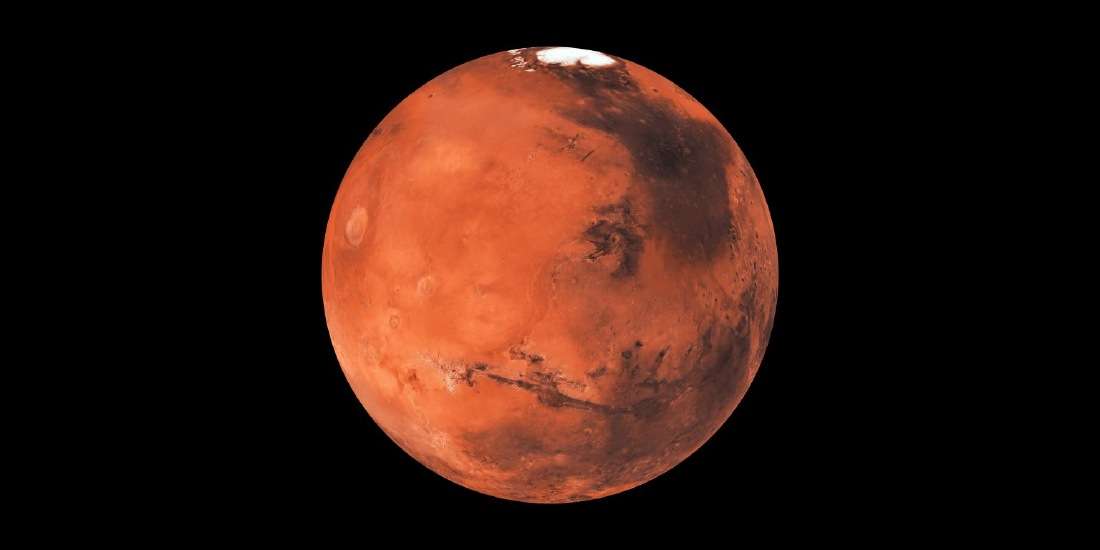
New research reveals water ice less than one meter beneath the Martian surface — a potential game-changer for human exploration.
Before humans can set foot on Mars, mission planners face an enormous challenge: finding a place to land that is not only safe but also offers the essential resources astronauts will need to survive. Unlike the Moon, where resupply missions from Earth take about a week, a round trip to Mars requires many months. Future Martian explorers will need to rely heavily on local resources — a strategy scientists call “in situ resource utilization” or ISRU.
Now, a groundbreaking study led by planetary geologist Erica Luzzi from the University of Mississippi has identified a region on Mars that may check all the boxes. Published in the Journal of Geophysical Research: Planets, the research reveals compelling evidence of water ice buried less than one meter below the surface in a region called Amazonis Planitia — and it could become humanity’s first doorstep to the Red Planet.
The Quest for Martian Water
Water is not just essential for drinking. On Mars, it represents the key to long-term survival. Through a process called electrolysis, water can be split into hydrogen and oxygen — providing breathable air for astronauts and, critically, rocket fuel for the return journey home. Without accessible water, any human mission to Mars would require transporting enormous quantities of supplies from Earth, making the endeavor exponentially more expensive and dangerous.

“If we’re going to send humans to Mars, you need H₂O and not just for drinking, but for propellant and all manner of applications,” Luzzi explained. “And finding it close to the surface is helpful because we can easily extract it and use it.”
While scientists have long known that Mars harbors vast quantities of water ice at its polar caps, those regions present significant challenges. Temperatures at the poles are extremely cold — far too harsh for astronauts or even most robotic systems to operate effectively. The terrain is rough, and landing spacecraft safely in those areas is exceptionally difficult.
The solution lies in the mid-latitudes — regions far enough from the equator to preserve ice but close enough to benefit from warmer temperatures and more sunlight for solar power generation. And that’s exactly where Amazonis Planitia sits.
High-Resolution Clues from Orbit
To find evidence of buried ice, Luzzi and her international team turned to one of the most powerful scientific instruments ever sent to another planet: the High Resolution Imaging Science Experiment (HiRISE) camera aboard NASA’s Mars Reconnaissance Orbiter. HiRISE can capture surface details as small as a kitchen table from orbit, allowing scientists to identify subtle geological features that hint at subsurface ice.
The team focused on three candidate landing sites within the Amazonis Planitia region, designated AP-1, AP-8, and AP-9. By carefully analyzing the images, they identified a range of ice-related surface features that strongly suggest frozen water lies just beneath the ground.
One of the most telling signs was polygonal terrain — networks of geometric cracks in the surface that form when subsurface ice expands and contracts with seasonal temperature changes. On Earth, similar patterns appear in permafrost regions like Siberia and northern Canada. On Mars, they serve as a reliable indicator of shallow ice.
The researchers mapped and measured approximately 9,000 thermal contraction polygons across the study area. Based on the size and geometry of these features, they estimated that ice could lie just tens of centimeters — roughly a foot or less — beneath the surface.
“The mid-latitudes offer the perfect compromise — they get enough sunlight for power, but they’re still cold enough to preserve ice near the surface,” Luzzi said. “That makes them ideal for future landing sites.”
Fresh Impact Craters: Windows into the Subsurface
Perhaps the most direct evidence of near-surface ice comes from fresh impact craters. When meteorites strike the Martian surface, they excavate material from below, sometimes exposing bright white ice that contrasts sharply with the reddish regolith.
The team identified several recent ice-exposing impact craters in and around the candidate landing sites. These natural “drill holes” confirm that water ice is indeed present at shallow depths in multiple locations.
However, the researchers also noted that not all impacts revealed ice, suggesting that the ice distribution is patchy rather than uniform. Understanding this variability will be crucial for future mission planning.
“We have strong evidence to suggest that this is water ice, but until we go there and measure it, we won’t be 100% sure,” said Giacomo Nodjoumi, a postdoctoral researcher at the Space Science Data Center of the Italian Space Agency and a co-author of the study.
Why Amazonis Planitia Stands Out
The Amazonis Planitia region offers more than just accessible ice. Located in Mars’ northern mid-latitudes, it benefits from a thicker atmosphere compared to other regions on the planet. This is significant because a denser atmosphere helps slow down descending spacecraft, making landing safer and more fuel-efficient.
The region also features relatively flat and smooth terrain — another critical factor for safe landings. Rocky, crater-filled landscapes increase the risk of catastrophic landing failures, so mission planners prioritize areas with gentle topography.
According to Sydney Do, project manager for NASA’s Subsurface Water Ice Mapping (SWIM) project at the Jet Propulsion Laboratory, the ideal landing site needs to balance multiple factors: “If you send humans to Mars, you want to get them as close to the equator as you can. The less energy you have to expend on keeping astronauts and their supporting equipment warm, the more you have for other things they’ll need.”
Amazonis Planitia sits at the southern edge of the ice-rich mid-latitude zone — potentially offering the best of both worlds: accessible water and relatively moderate temperatures.
The SWIM Project: Mapping Mars’ Hidden Water
This new research builds upon years of work by NASA’s SWIM project, which has been systematically mapping subsurface water ice across Mars since 2017. Led by the Planetary Science Institute in Tucson, Arizona, and managed by NASA’s Jet Propulsion Laboratory, SWIM combines data from multiple Mars missions including the Mars Reconnaissance Orbiter, 2001 Mars Odyssey, and the Mars Global Surveyor.
The project uses five independent data sets — thermal readings, radar signals, hydrogen abundance, surface imagery, and neutron spectrometry — to identify areas where ice is most likely present. Locations where multiple data sets converge are considered high-priority targets for future exploration.
The latest SWIM maps, released in 2023, represent the most detailed view yet of where Martian ice hides beneath the surface. These maps are already being used to inform planning for future robotic and human missions.
“Our maps are important for future landed missions, both robotic and human,” said Nathaniel Putzig, SWIM co-principal investigator. “Mission planners looking to study shallow ice can use our maps as part of their landing site selections.”
Beyond Survival: The Search for Ancient Life
While the practical benefits of accessible water ice are clear, the scientific implications are equally profound. Ice on Mars may preserve more than just frozen water — it could harbor clues about whether the Red Planet ever supported life.
“This also has astrobiological implications,” Luzzi explained. “On Earth, ice can preserve biomarkers of past life, and it can also host microbial populations. So, it could tell us if Mars was ever habitable.”
If microbial life ever existed on Mars — billions of years ago when the planet was warmer and wetter — traces of that life might still be locked within ancient ice deposits. Ice acts as a natural time capsule, protecting organic molecules and other biosignatures from the harsh radiation that bombards the Martian surface.
Additionally, scientists recently published findings in National Science Review suggesting that liquid water may exist deep beneath Mars’ surface — between 5 and 8 kilometers down — based on seismic data from NASA’s InSight lander. While this deep water would be inaccessible to astronauts, its presence reinforces the picture of Mars as a planet with a complex water cycle, past and possibly present.
What Comes Next?
Despite the compelling evidence, scientists caution that confirmation requires direct measurements. The next step would involve radar analyses from orbit to better characterize the depth and patchiness of the ice, followed by robotic precursor missions that could drill into the surface and analyze samples directly.
“The next step would be radar analyses to better understand the depth and patchiness of the ice,” Luzzi said. “Understanding that will help us decide where a robotic precursor should land.”
NASA and international partners are actively working toward these goals. A proposed mission called Mars Ice Mapper, developed in collaboration with agencies from Italy, Canada, and Japan, would deploy a dedicated satellite equipped with advanced radar specifically designed to map shallow ice deposits with unprecedented precision.
Meanwhile, commercial space companies like SpaceX continue to develop the heavy-lift rockets and landing systems needed to transport humans to Mars within the coming decades. With each new discovery, the path to that historic first landing becomes a little clearer.
A New Chapter in Space Exploration
Humanity has dreamed of walking on Mars for generations. Now, for the first time, scientists are identifying not just where we might land, but where we should land — places where astronauts can access the resources they need to survive, work, and eventually return home.
Amazonis Planitia may not be a household name yet. But if current research holds up, it could become one of the most important locations in human history — the place where our species takes its first steps on another world.
“We will never be sure of something if we don’t have a rover, a lander or a human to take real measurements,” Nodjoumi said. “But we have strong evidence to suggest that this is water ice, and that makes our candidate landing site really promising.”
The Red Planet is calling. And now, we may finally know where to answer.

